History
A thousand years above Loch Ness
From Pictish nobles to Jacobite gunpowder, the story of Urquhart Castle spans over a millennium of Scottish history.
Why Urquhart Castle matters
Urquhart Castle isn't just a pretty ruin on Loch Ness — it's one of the most fought-over castles in Scotland. Its position on Strone Point controlled the Great Glen, the natural corridor linking the east and west Highlands, which made it enormously valuable to whoever held it. Over 500 years it changed hands more than a dozen times between Scottish kings, English invaders and rival Highland clans.
What survives today is a mix of every era that shaped the site: medieval curtain walls, a 16th-century tower house, a working kiln, a chapel, a prison cell and the twin-towered gatehouse that government troops blew up in 1692 to keep it out of Jacobite hands. That final blast is why the castle looks the way it does — famously ruined, endlessly photogenic, and open to the sky.
A timeline of Urquhart Castle
c. 580 AD
Pictish beginnings
St Columba is said to have visited a Pictish nobleman on this rocky promontory — the earliest record of settlement here.
13th century
The medieval castle rises
The Durward and Comyn families build a stone castle to control the Great Glen.
1296–1332
Wars of Scottish Independence
Urquhart changes hands repeatedly between English and Scottish forces. Robert the Bruce recaptures it after his coronation.
15th–16th c.
Clan wars
Raided again and again by the MacDonald Lords of the Isles. The Grant family becomes keepers and rebuilds the tower.
1692
The great blast
Government troops blow up the gatehouse to stop Jacobites using it — leaving the romantic ruin you visit today.
Today
Cared for by Historic Environment Scotland
One of the most-visited castles in Scotland, with a modern visitor centre on Loch Ness.
What you can still see today
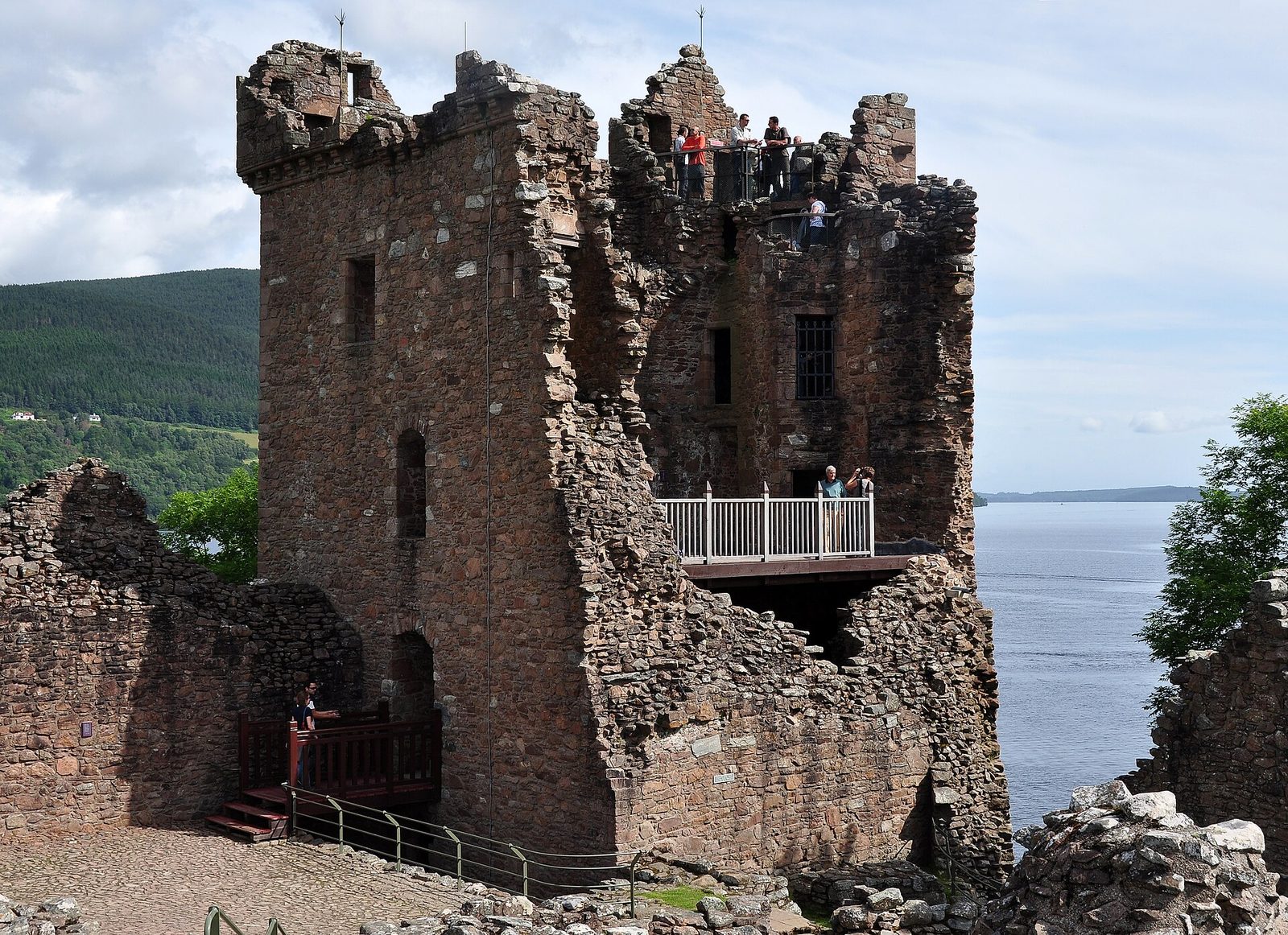
The Grant Tower is the tallest surviving part of the castle and the classic climb for visitors. From the top you get a five-storey view over Urquhart Bay and Loch Ness — arguably the finest photo spot on the whole loch.
The gatehouse, dramatically split in two by the 1692 explosion, still guards the landward approach. A working trebuchet — a full-size replica of a medieval siege engine — stands nearby to remind visitors how the castle was attacked.
Look out too for the water gate down at the loch shore, the tiny prison cell cut into the rock, the ruined chapel, and the kiln where grain was dried before milling. The modern visitor centre, tucked into the hillside above, houses a short film, a museum of medieval finds, a gift shop and a café with panoramic loch views.
Ready to visit? See our tickets and opening times page, or read up on Loch Ness itself.